Knowing AI Is Not Enough Anymore

A year ago, “knowing how to use AI” was already impressive. Today, it’s becoming the minimum requirement. Employers no longer ask: “Can you use AI?”
They ask: “Can you create more value with AI than other people?” Because the truth is: People who don’t use AI may be replaced, but people who only use AI at a basic level may also struggle to grow.
AI tools are becoming accessible to everyone. The real advantage is no longer the tool itself.
The advantage comes from: how you think, how you make decisions, how you solve problems, how you combine AI with strategy, systems, and business understanding
And this is where the gap between “using AI” and “working with AI” becomes very important.
This article will help you to understand the differences between ‘using AI’ and ‘working with AI’, and share with you some ‘foundation skills’ you need to make you stand out from other people who are ‘using AI’.
The Difference Between “Using AI” and “Working With AI”
A few years ago, knowing Figma was already valuable. Then everyone learned Figma. Today, AI is following the same path.
Simply knowing how to prompt ChatGPT, generate UI screens, or create AI content is quickly becoming a baseline skill. When everyone has access to the same tools, work value and mindset become the real competitive advantage.
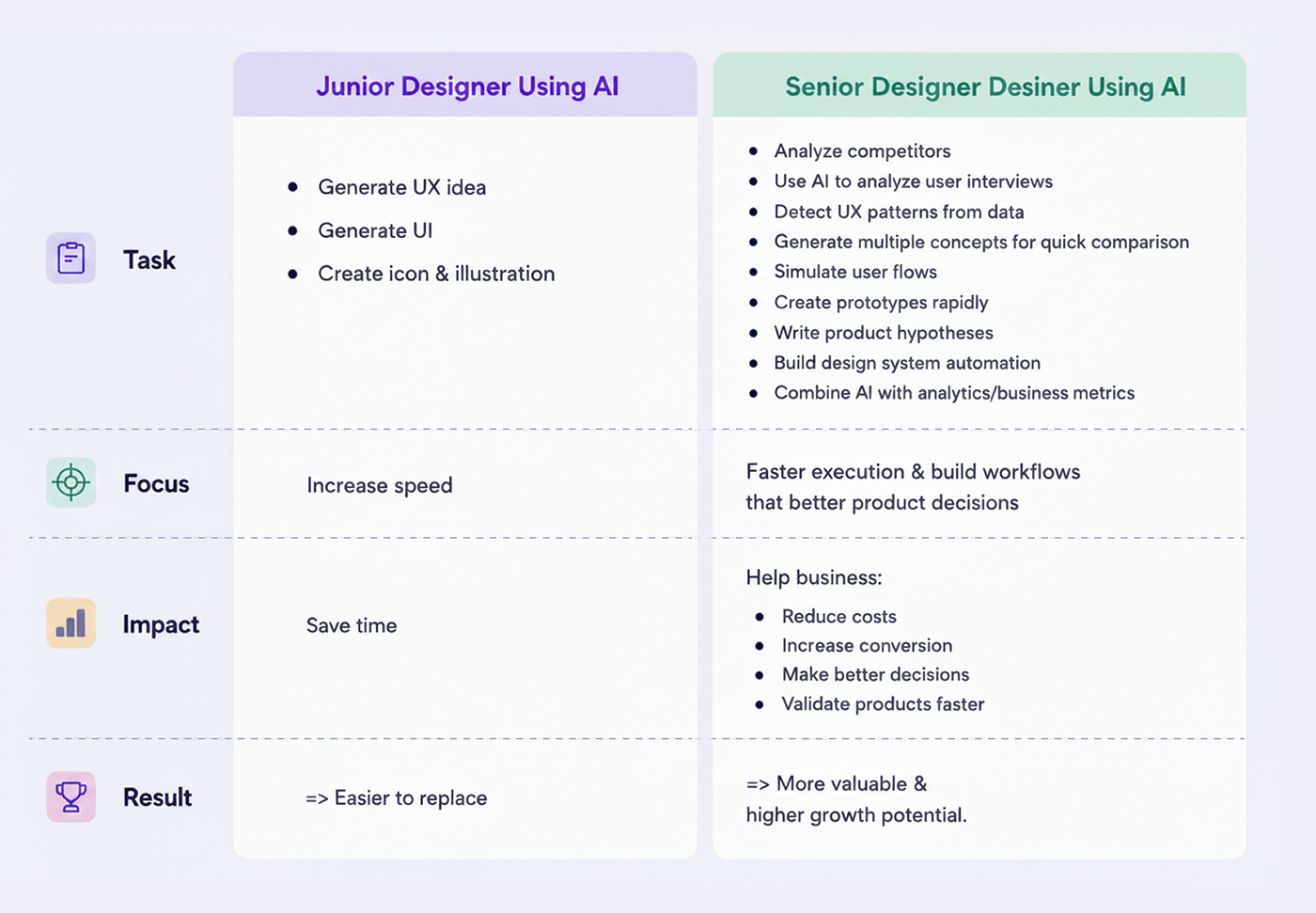
A senior designer or product designer uses AI differently.
The difference is not whether you use AI because almost everyone will. The difference is whether AI simply makes you faster or makes you more valuable.
What Designers Need To Learn To Stay Valuable?
According to the World Economic Forum’s Future of Jobs Report 2025, the fastest-growing skills toward 2030 are not just AI literacy, but also include some skills that you frequently hear: analytical thinking, creativity, systems thinking, adaptability, leadership, collaboration with AI, etc. That’s totally correct.
However, in this article, I’d love to talk about different aspects and divide them into 2 foundational skills so that all of you can easily understand them. Why do I call it ‘foundational skill’? — Because they are the core thinking abilities behind not only design, but also product development, or any other industry.
Before AI existed, these skills were already valuable. And after AI, they become even more important.
Skill 1: Ask Better Questions
As Warren Berger explores in A More Beautiful Question (2014), the ability to ask the right questions is one of the most powerful. Questions drive learning, innovation, and change. Modern society often focuses too much on finding quick answers (and also answers from AI), while true value comes from asking better questions.
AI can generate product ideas, wireframes, UI screens, and research summaries, but AI cannot fully determine:
- Does the solution solve the right problem?
- Do user actually need it?
- Why did the problem happen?
- How can this be better?
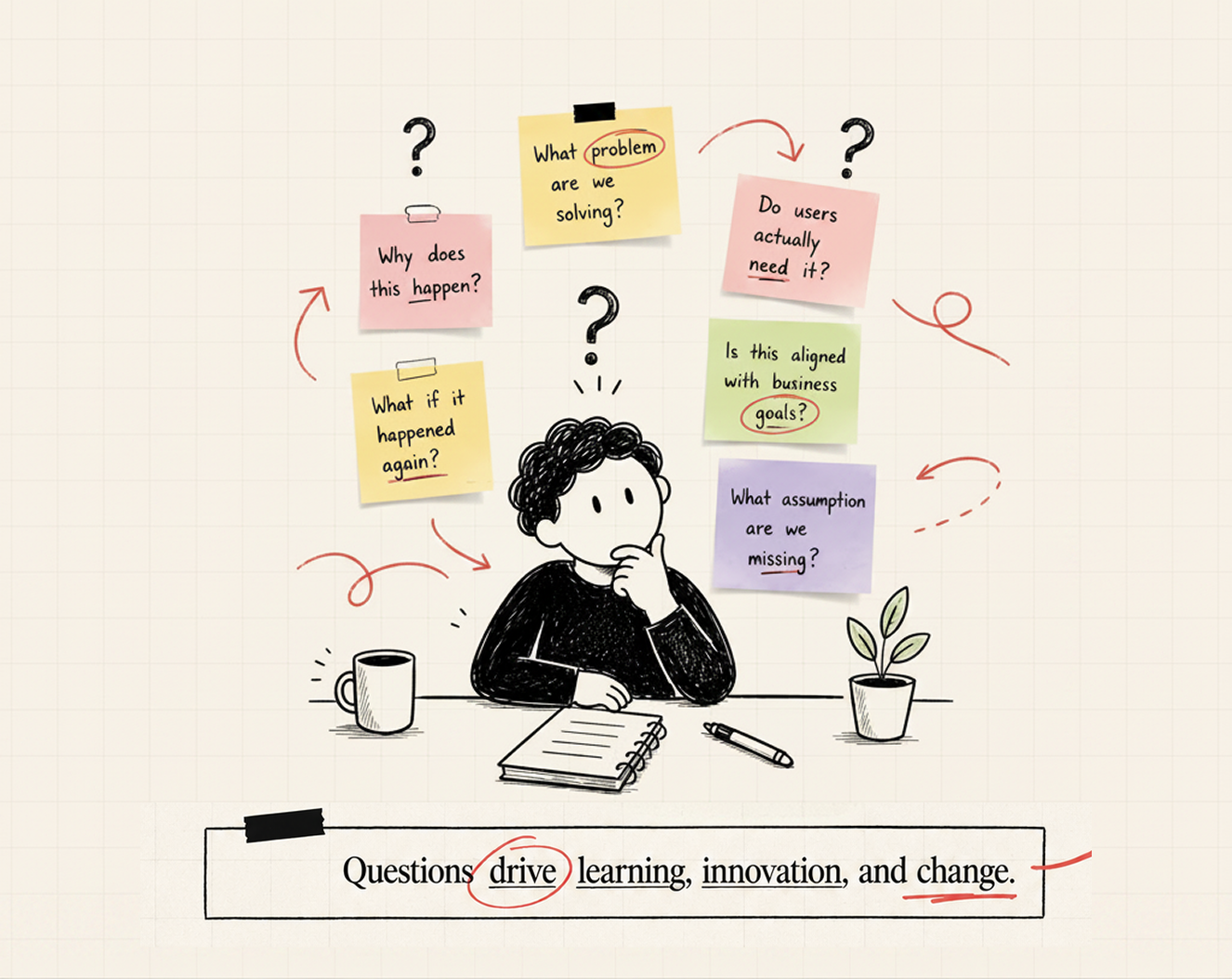
So, depending on the specific problem and context, asking the right questions not only helps solve problems but also helps us understand ourselves better, see the world more deeply, and create new opportunities. It is also the foundation for understanding the core of business problems and many of the challenges we want to solve.
Skill 2: Evaluate Answers
There are a million answers around us. People often trust quick answers, intuition, and emotions, but these responses can easily be influenced by cognitive biases, especially in the AI era. So, evaluating answers becomes more important. But how can we right evaluate the answer? To evaluate an answer more effectively, we need to:
- View the problem from multiple perspectives
- Ask and debate with our own assumptions and thinking
- Examine data and evidence
- Discuss with people who are better than you
Slow down before making conclusions
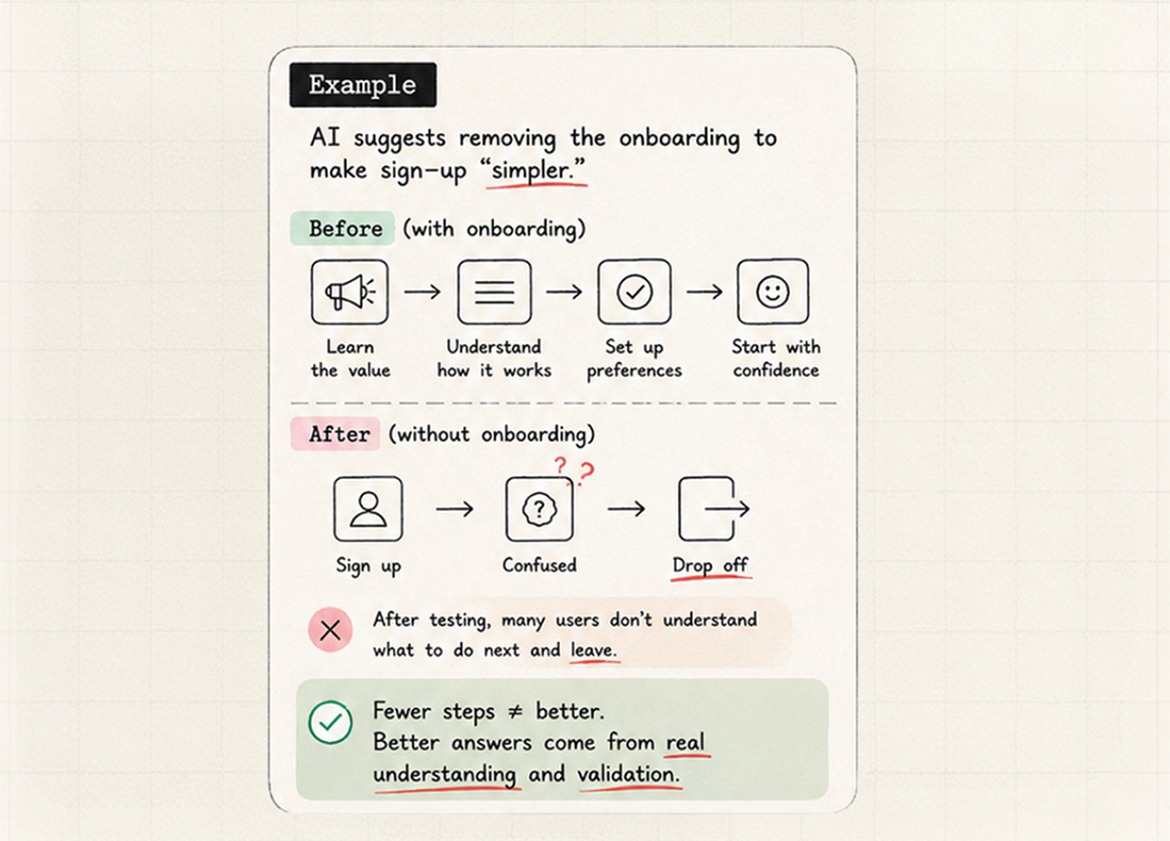
For example, AI suggests reducing the number of steps to make a flow “simpler. This example shows that the intuition “fewer steps = better” is not always correct.
A correct answer is not just something that “sounds reasonable,” but something that can withstand logical and real-world validation, which is to help you make better decisions.
Catch Up
One more important thing is: Don’t fear AI replacing your job. AI may automate parts of the work. But the people who stay valuable will be the ones who have foundation skills: asking better questions and evaluating answers correctly.
Because in the end, AI is just a tool. The real advantage will come from how deeply you think, how well you understand problems, and how effectively you turn AI into meaningful value.
What matters most is that you dare to try and give it your all. Life is still good! :)